In a previous article (https://test.jinshomes.com/3-things-to-check-before-buying-a-short-term-rental/), we explained that evaluating a potential short-term rental property involves three key steps:
• Whether the property can meet licensing requirements
• Capacity planning — bed configuration, renovation, and furnishing costs
• Financial projections
This article focuses on the third step: estimating net income.
Estimating Revenue
To estimate potential revenue, we analyze comparable listings of similar quality and guest capacity in the surrounding area.
We review booking calendars for the next three months and use the rates of highly occupied properties as the baseline for our estimates.
Note: When reviewing Airbnb listings, the displayed nightly price often includes a portion of the cleaning fee averaged across the stay. To approximate the true nightly rate, we discount the displayed price by several thousand yen to account for embedded cleaning costs.
For practical purposes, we define “highly occupied” as properties that are booked for:
• 20 or more nights in the current month
• 15 or more nights in each of the following two months
For Tokyo properties, we typically assume:
• 15 occupied nights per month for properties with a minpaku license (limited to 180 nights per year), which can often be supplemented with a few months of monthly rentals
• 20–25 occupied nights per month for properties with a hotel license
Occupancy and pricing vary seasonally, but this simplified approach is generally sufficient for initial screening.
Estimating Operating Costs
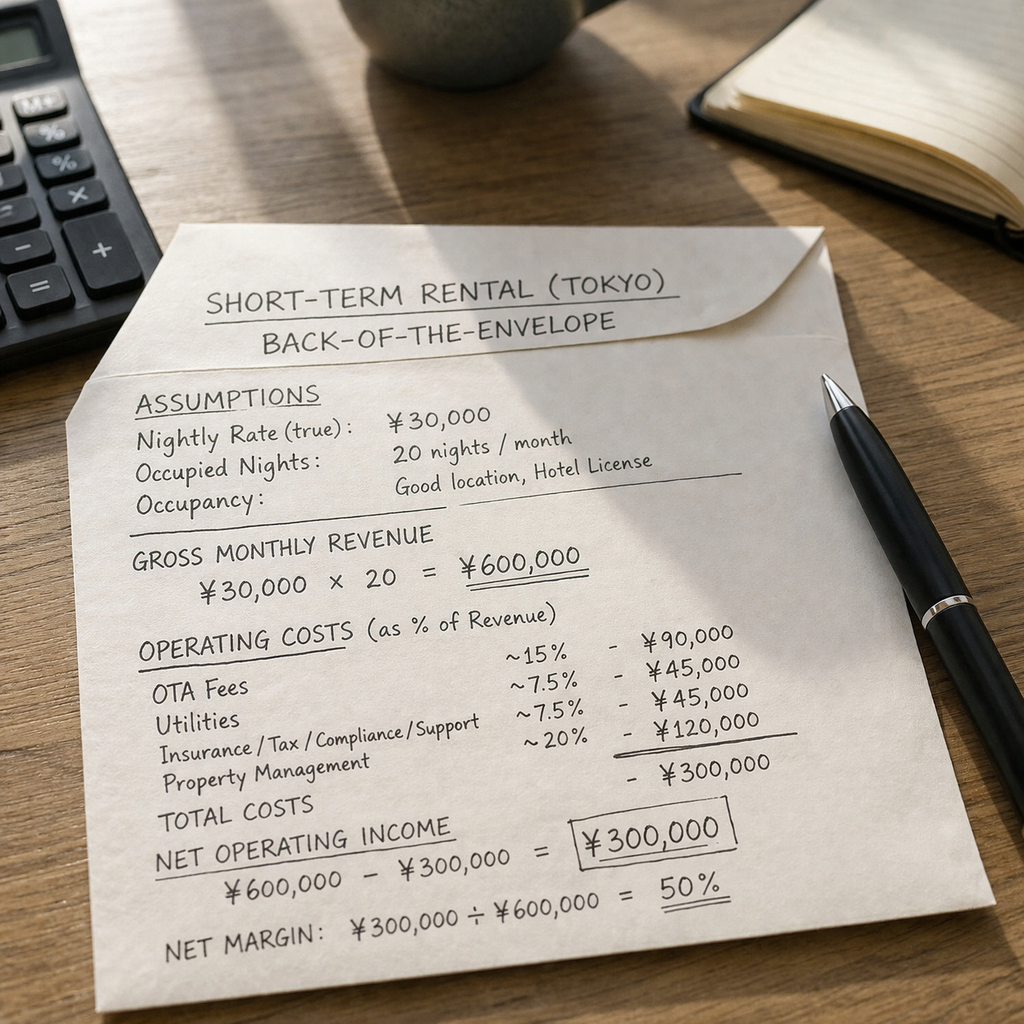
Once gross revenue is estimated, operating costs must be deducted to approximate net income. We use the following assumptions for quick back-of-the-envelope calculations in Tokyo.
OTA Fees — approximately 15%
Platforms such as Airbnb and Booking.com charge commissions that vary by platform (Airbnb ~15.5%, Booking.com roughly 12–15% as of May 2026). Using 15% as a baseline is reasonable for preliminary analysis.
Cleaning
Cleaning costs are typically passed on to guests as a separate fee. When priced appropriately, they can be treated as largely cost-neutral.
Utilities — approximately 7.5%
Utilities include electricity, gas, water, internet, and consumable supplies. Because usage increases with occupancy, estimating these costs as a percentage of revenue is practical.
Insurance, Taxes, Compliance, and Support — approximately 7.5%
Less visible expenses can materially affect profitability, including:
• Property insurance
• Guest liability coverage
• Property tax
• Fire safety inspections and maintenance
• Emergency response or local support personnel
Consumption Tax (if applicable, 10%)
If the property owner is subject to consumption tax (generally exceeding JPY 10 million in taxable revenue), the 10% tax should be factored into revenue projections.
Property Management Fees — approximately 15–25%
Full-service property management for short-term rentals in Tokyo typically falls within this range as a market norm.
A Practical Net Income Rule of Thumb
After accounting for the above costs, net operating income for a short-term rental in Tokyo typically falls in the range of 45–55% of gross revenue.
For detailed evaluation, we recommend modeling seasonal occupancy and pricing on a month-by-month basis. However, performing this level of analysis for every potential opportunity is inefficient.
For initial screening, assuming that roughly 50% of gross revenue becomes net income is usually sufficient and unlikely to produce major deviations. If a property still appears attractive under this assumption, it may warrant deeper investigation.
If you are evaluating a specific property in Tokyo, feel free to book a call to discuss its feasibility:
https://calendly.com/yoshi-jinzaki-jinshomes/new-meeting